
 EN
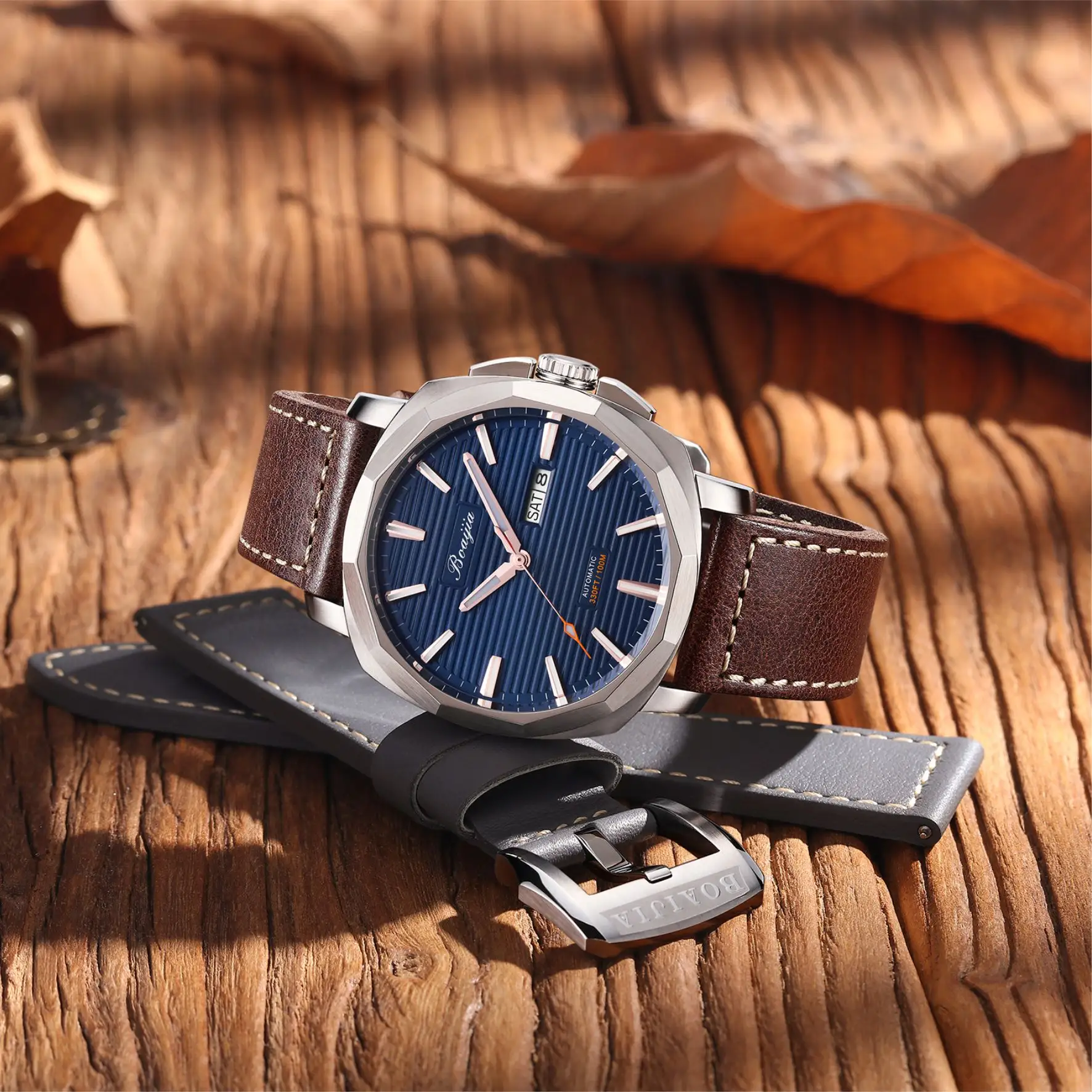
Precision rarely comes from the machine spec sheet. It comes from how the cutting tool actually behaves under load and how well the process holds that behavior consistent. A watch part, whether a case, a buckle, a bracelet link, or a dial blank, carries a tolerance stack that starts at the raw material. Every cutting pass adds one number to that stack, and the errors add up.
CNC machining matters here not because it sounds advanced, but because it makes the tool path repeatable. Same program, same tool, same material, and the part comes out the same across different batches. On an older manual machine, the operator's feel enters the cut, and feel cannot be audited.
Multi-axis work pushes this a step further. A part that needs four faces cut in one setup, if moved to a second machine, adds one more clamping error. If the same machine completes the cut, the part stays in the same fixture, and the stack gets shorter. That is the real benefit. Not just a better surface, but fewer chances for error to enter.
Case Machining: Where Geometry and Finish Meet
Case geometry is where CNC accuracy shows most clearly. Lug width, crown tube seat, case back thread engagement, and the sealing groove all come off the cutting operation. An error in any of them becomes a fit problem later.
The sealing groove is a good example. Its depth and diameter decide how much the gasket gets compressed, and compression decides whether the gasket holds against water pressure. A groove that is a little shallow gives less compression. One that is deep over-compresses the gasket and can deform it over time. The window is tight in geometric terms, and CNC holds it with more repeatability.
Surface finish and geometry interact. A case that gets a rough cut with chatter marks and then a long polish to hide them loses dimensional accuracy in the process. A case that gets a finishing pass close to final size, with a clean surface, needs less polishing and holds its shape better. The choice of CNC machining parameters decides which path is available.
Bracelet Links and Buckles: Small Parts, Tight Windows
Bracelet links and buckles are where precision gets less visible and more important. A link with a hole position off by a hundredth of a millimeter will bind or rattle once assembled. A buckle with a spring pocket a few hundredths too deep changes the feel of the open force.
CNC machining helps in both cases because the tool path can lock hole positions, pocket depths, and edge radii into the same program. Manual work depends on the operator's skill to hold those dimensions. When the parts run in volume, CNC shows its advantage in keeping batch-to-batch consistency.
Stamping and CNC play different roles here. Stamping is faster and suits higher volume, but the tooling decides what is feasible. CNC is more flexible when shapes are complex, tolerances are tight, and volume is not high enough to justify a die. Many bracelet and buckle projects end up using both, with stamping for the body and CNC for finishing passes.
| Method | Best suited for | Limitation |
|---|---|---|
| Multi-axis CNC | Complex geometry, tight tolerances | Higher unit cost at low volume |
| Single-axis CNC | Simple turned parts | More setups per part |
| Stamping | Higher volume, simpler shapes | Tooling cost, shape limits |
| Automated polishing | Consistent surface finish | Cannot correct dimensional error |
A Case Where Tool Wear Showed Up in the Batch
One anonymized case involved a run of cases with a sealing groove issue. First articles measured inside tolerance. Later batches started showing a slight difference in groove depth. Every individual part was still inside spec, but the batch mean had drifted.
The root cause was tool wear on the groove milling operation. The cutter was dulling, and the cut got slightly shallower on each pass. Each individual part passed inspection. The trend only showed up when records were compared across lots.
The fix was not a machine change. It was a tool change schedule based on part count and time, set before the inspection started failing rather than after. That is a broader point about CNC machining accuracy. It is not just about having the machine dialed in. It is about managing the things that change over time, like tool wear.
What CNC Cannot Fix
It is worth being honest about what CNC machining does not fix. It does not fix a flawed design. A part with a tolerance stack that cannot work will not become workable because the cut is more precise. It does not fix rough material. A blank with inclusions or uneven hardness will cut with uneven surface, no matter how good the program.
It also does not replace surface finishing. A case with perfect geometry and inadequate polishing still looks half-finished in the hand. CNC decides shape and consistency. Surface quality still comes from the finishing steps that follow.
There is also a price point. Stamping gets cheaper than CNC at higher volume, even when CNC could match the shape. The choice depends on volume, shape complexity, and tolerance needs, not on precision alone.
Why Accuracy Is a Process Decision, Not a Machine Spec
The precision on a machine spec sheet is its best case. The precision that actually shows up in a batch depends on fixturing, tool change discipline, temperature control, and inspection frequency. That is why two shops with the same machine can produce different results.
An experienced components specialist that adheres to these standards can usually explain where the accuracy comes from in each batch. That requires tracking tool wear, checking first and last pieces at defined intervals, and tying inspection records back to the production conditions. CNC machining is the tool. Process is what makes it hold.
For projects where cases, dials, bracelets, and buckles need to balance precision with production volume, working with a supplier that builds its machining around those factors reduces late surprises. Burriva, short for Baoruihua (Dongguan) Precision Technology Co., Ltd., operates a component-focused facility with over 20,000 square meters of floor space, covering multi-axis machining, CNC milling, stamping, automated polishing, and dimensional inspection across incoming, in-process, and outgoing stages. Workflows are segregated by project, and CAD file access is controlled by job role. Teams working through watch part machining specifications are welcome to discuss their requirements.