
 EN
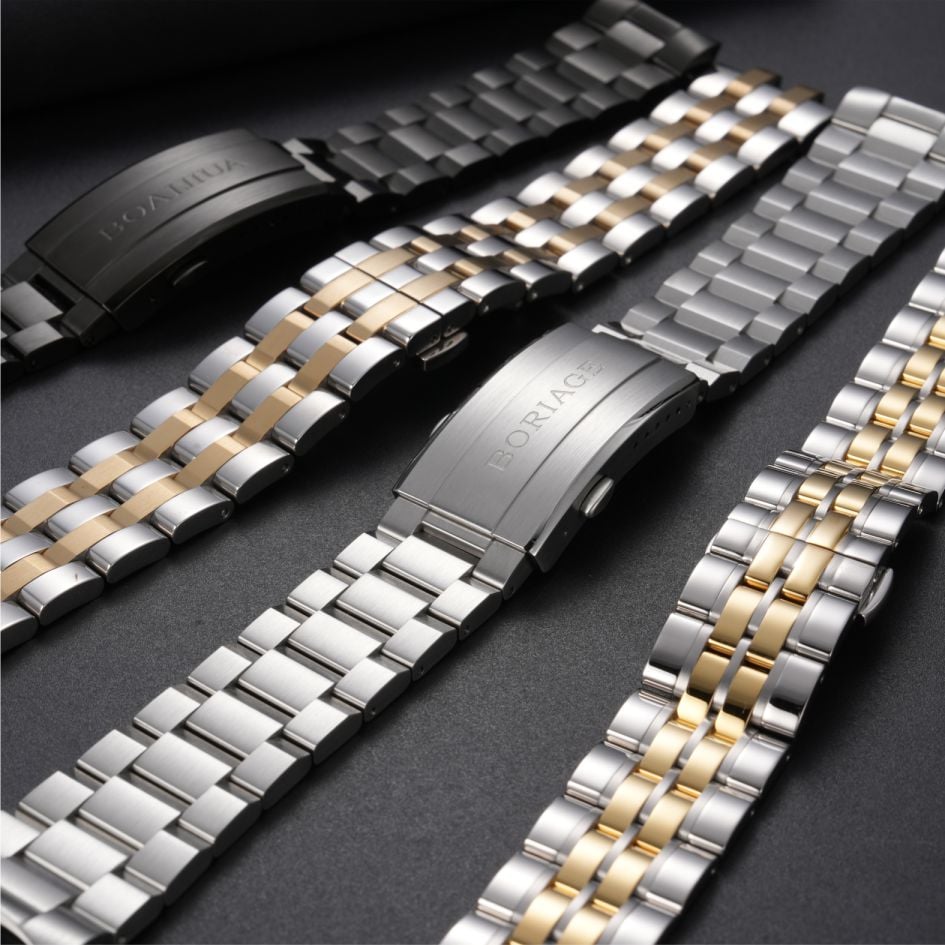
Titanium shows up on watch specifications for a reason that has little to do with marketing. It is light, it resists corrosion, and it behaves well against skin. On a watch case, those properties are nice to have. On a buckle, they matter more, because the buckle is the part that sits against the wrist all day and gets pressed, opened, and closed repeatedly.
A titanium watch buckle weighs noticeably less than the same buckle in 316L stainless steel. Density is roughly 4.5 g/cm³ for titanium against 7.9 for steel, so the difference is real and it shows up in the hand. A lighter buckle changes how the watch sits on the wrist, especially on a bracelet where the clasp carries a meaningful share of the total weight.
Corrosion resistance is the second advantage. Titanium forms a thin oxide layer on its surface that protects it against sweat, salt water, and the general wear of daily use. The layer reforms if it is scratched, which is why titanium holds up well in conditions that would dull a lower-grade steel.
Skin Contact and the Hypoallergenic Argument
The buckle is the component that spends the most time in direct contact with skin. That makes nickel release a practical concern, not a theoretical one. Some stainless steel grades release small amounts of nickel when they contact sweat, and for wearers with a nickel sensitivity, that shows up as irritation under the clasp.
Titanium does not carry that problem in the same way. It is generally well tolerated against skin, and it is often chosen for that reason alone. The honest caveat is that not all titanium is identical. Commercially pure grades and alloys behave slightly differently, and the surface finish also affects how the metal interacts with skin. A rough or contaminated surface can cause issues that the base material would not.
Machining Titanium Is Where the Cost Comes From
Titanium is more expensive than steel at the material level, and it is also more expensive to machine. The reasons are physical. Titanium conducts heat poorly, so heat builds up at the cutting edge instead of moving into the chip or the workpiece. That shortens tool life and requires more careful control of cutting speed and coolant.
Titanium also work-hardens. A light cut can leave a hardened layer that makes the next pass harder on the tool. Machining parameters have to be set to cut through that layer rather than skate across it, which means slower feeds and more attention to tool condition.
The material's lower modulus, around 110 GPa against roughly 200 for steel, adds a third wrinkle. Titanium deflects more under cutting force, so thin sections like buckle plates and latch leaves can spring away from the cutter. Fixturing and support have to account for that, or the part comes out with a taper that the inspection will catch later.
| Property | Titanium | 316L stainless steel |
|---|---|---|
| Density | About 4.5 g/cm³ | About 7.9 g/cm³ |
| Modulus | About 110 GPa | About 200 GPa |
| Corrosion resistance | High, oxide layer reforms | Good, depends on grade and finish |
| Skin tolerance | Generally well tolerated | Nickel release possible in some grades |
| Machining difficulty | Higher, heat and work hardening | Lower, well understood |
| Material and unit cost | Higher | Lower |
A Case Where the Spring Did Not Match the Steel Version
One anonymized case involved a titanium buckle that was designed as a direct material swap from an existing steel version. The geometry was carried over, the spring was carried over, and the first articles looked correct.
The open force did not. The titanium buckle felt lighter to open than the steel version, even though the spring was identical. The cause was the modulus difference. The same spring, compressing against a latch leaf that deflected more, delivered less felt force. The buckle was not defective. The spring spec had been tuned around steel and did not carry over.
The fix was to adjust the spring rate and the preload for the titanium version, then recheck the open force across the batch. That is a useful reminder that swapping materials on a buckle is not a like-for-like change. The spring, the latch, and the hinge all respond to the material's stiffness, and each one has to be revalidated.
Finish and Color Options That Hold Up
Titanium takes a different range of finishes than steel. Polished titanium has a slightly warmer tone than polished steel, and brushed titanium holds a matte look that many brands prefer for a tool-watch aesthetic. Bead-blasted and satin finishes are also common.
Color is where titanium gets interesting and also where it gets tricky. Titanium can be anodized to produce a range of colors without a coating, which means the color is part of the oxide layer rather than a layer on top. That holds up better against wear than a thin coating, but the color range is limited and the process is sensitive to surface preparation.
PVD coating is also used on titanium, mainly for darker tones and for added scratch resistance. The same rules apply as on steel. Substrate condition decides the final look, and a coating cannot fix a rough surface.
What Titanium Does Not Solve
It is worth being clear about the limits. Titanium does not make a buckle stronger in every sense. It has good strength-to-weight, but it is not harder than steel, and it scratches more easily in daily use. A titanium buckle that contacts a hard surface will show marks that a hardened steel buckle would resist.
Titanium is also not the right choice for every price point. Material and machining costs push the unit price up, and for a buckle that is not meant to be a visible design feature, the premium may not return value. The choice depends on how the watch is positioned, how the buckle is meant to feel, and how much weight saving actually matters on the wrist.
Where Titanium Buckle Sourcing Gets Practical
Titanium buckles can be sourced from a single supplier that handles machining, finishing, and inspection, or split across specialists. Neither setup is universally better. A single source makes drift easier to trace. A multi-supplier setup gives access to narrower expertise but puts more compatibility checking on the brand.
Small volume orders follow the same quality standards as large ones. The inspection plan and the AQL levels do not change with batch size. Unit price does change, because titanium tooling and inspection planning are fixed costs that spread across fewer pieces.
An experienced components specialist that adheres to these standards can usually explain where the cost sits in a titanium buckle and which design choices drive it. That is more useful than a headline material claim.
For projects where titanium buckles need to balance weight, skin contact, and machining cost, working with a supplier that builds its QC around those factors reduces late surprises. Burriva, short for Baoruihua (Dongguan) Precision Technology Co., Ltd., operates a component-focused facility with over 20,000 square meters of floor space, covering multi-axis machining, CNC milling, stamping, automated polishing, and dimensional inspection across incoming, in-process, and outgoing stages. Workflows are segregated by project, and CAD file access is controlled by job role. Teams working through titanium buckle specifications are welcome to discuss their requirements.