
 EN
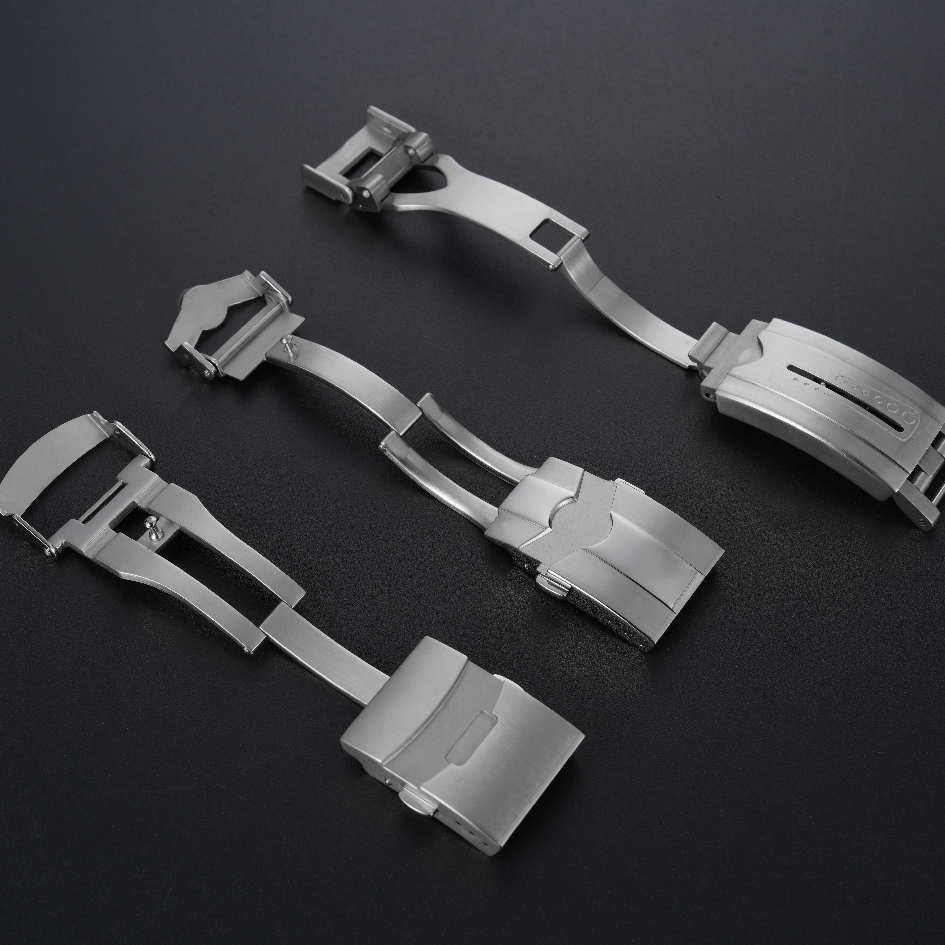
A clasp fails for one of a few reasons: the latch stops engaging, the spring loses tension, the surface wears through, or the hinge develops play. Each of those failure modes traces back to a material property. Hardness decides how fast the surface scratches. Modulus decides how much a latch leaf deflects under load. Corrosion resistance decides how the part behaves against sweat over months.
Material selection is therefore not a cosmetic decision. It sets the wear clock for the clasp before a single unit is produced. Two clasps with identical geometry and different materials will age differently, and the difference shows up in the hand long before it shows up in a specification sheet.
316L Stainless Steel as the Practical Baseline
316L stainless steel is the baseline for watch clasps for reasons that hold up in production. It resists corrosion well enough for daily skin contact, takes both brushed and polished finishes, and machines and stamps predictably. Its hardness sits in a range that holds a latch edge without being brittle.
The limitation is wear. 316L is not a hard steel, and a polished surface on a clasp will pick up fine scratches over time. That is acceptable on a brushed finish, where the scratches blend in. On a mirror-polished clasp, the same wear reads as dulling, and the part looks older than it is.
The other baseline issue is nickel release. Some wearers are sensitive to it, and 316L can release small amounts when it contacts sweat. For most users this is a non-issue. For a brand targeting sensitive-skin wearers, it is a reason to consider alternatives.
Titanium and the Modulus Trade-Off
Titanium clasps solve the weight and skin-contact issues that steel carries. Titanium is roughly 40 percent lighter than steel at the same volume, and it is generally well tolerated against skin. It also resists corrosion through a surface oxide layer that reforms after scratches.
The trade-off is modulus. Titanium's elastic modulus is around 110 GPa against roughly 200 for steel, so a titanium latch leaf deflects more under the same load. A spring tuned for a steel clasp will feel lighter in a titanium version unless the spring rate is adjusted. That is a design change, not a material swap, and it has to be validated across the batch.
Titanium is also softer on the surface than hardened steel. It resists corrosion better but scratches more easily. A titanium clasp that contacts a hard surface in daily use will show marks that a steel clasp would resist.
| Property | 316L steel | Titanium | PVD-coated steel |
|---|---|---|---|
| Hardness | Moderate | Lower | Higher at surface |
| Corrosion resistance | Good | High | Depends on coating integrity |
| Skin tolerance | Nickel release possible | Generally well tolerated | Same as substrate |
| Scratch visibility | Moderate | Higher | Lower until coating wears |
| Unit cost | Baseline | Higher | Moderate to higher |
Coating Durability and the Substrate Question
PVD coating is often specified to improve scratch resistance and to add color. The coating does raise surface hardness, and a well-applied layer holds up better than an uncoated steel surface against light abrasion.
The catch is that the coating is only as good as the substrate underneath. A PVD layer on a surface with pits, tool marks, or edge burrs will show those defects through the coating rather than hide them. When the coating wears through at a high-contact point, the steel underneath is exposed and the color shifts. That shift is visible and reads as wear even when the part is structurally fine.
Coating thickness matters at both ends. Too thin and it wears through early. Too thick and it can round an edge that needs to stay sharp for latch engagement. The usable window is narrow, and it has to be checked on the coated part rather than assumed from the process spec.
A Case Where the Material Cert Did Not Match the Part
One anonymized case involved a batch of clasps that passed incoming inspection and started showing surface wear earlier than expected in field use. The material certificate listed the correct grade. Hardness checks on the raw stock were inside spec.
The problem was in the heat treatment of the stamped parts. A batch had been processed at a temperature that left the surface softer than the specification intended, and the hardness check on the raw stock did not catch it because the stock was tested before stamping and heat treatment. The parts were the right grade and the wrong condition.
The fix was to add a hardness check on the finished stamped part rather than only on incoming stock, and to tie the heat treatment record to the batch. The material was not the issue. The verification sequence was.
What Material Selection Cannot Fix
Material choice does not fix a design that puts stress on the wrong point. A latch edge that is too thin will fail in any material. A spring pocket that is too shallow will give a soft feel regardless of the steel grade.
It also does not replace surface finishing. A clasp in the right material with a poor polish still looks unfinished in the hand. And it does not solve the cost question on its own. Titanium and PVD add cost, and that cost only returns value if the clasp is meant to be a visible, durable feature.
For projects where clasp material needs to balance wear, skin contact, and cost, working with a supplier that builds its QC around those factors reduces late surprises. Burriva, short for Baoruihua (Dongguan) Precision Technology Co., Ltd., operates a component-focused facility with over 20,000 square meters of floor space, covering multi-axis machining, CNC milling, stamping, automated polishing, and dimensional inspection across incoming, in-process, and outgoing stages. Workflows are segregated by project, and CAD file access is controlled by job role. Teams working through clasp material specifications are welcome to discuss their requirements.