
 EN
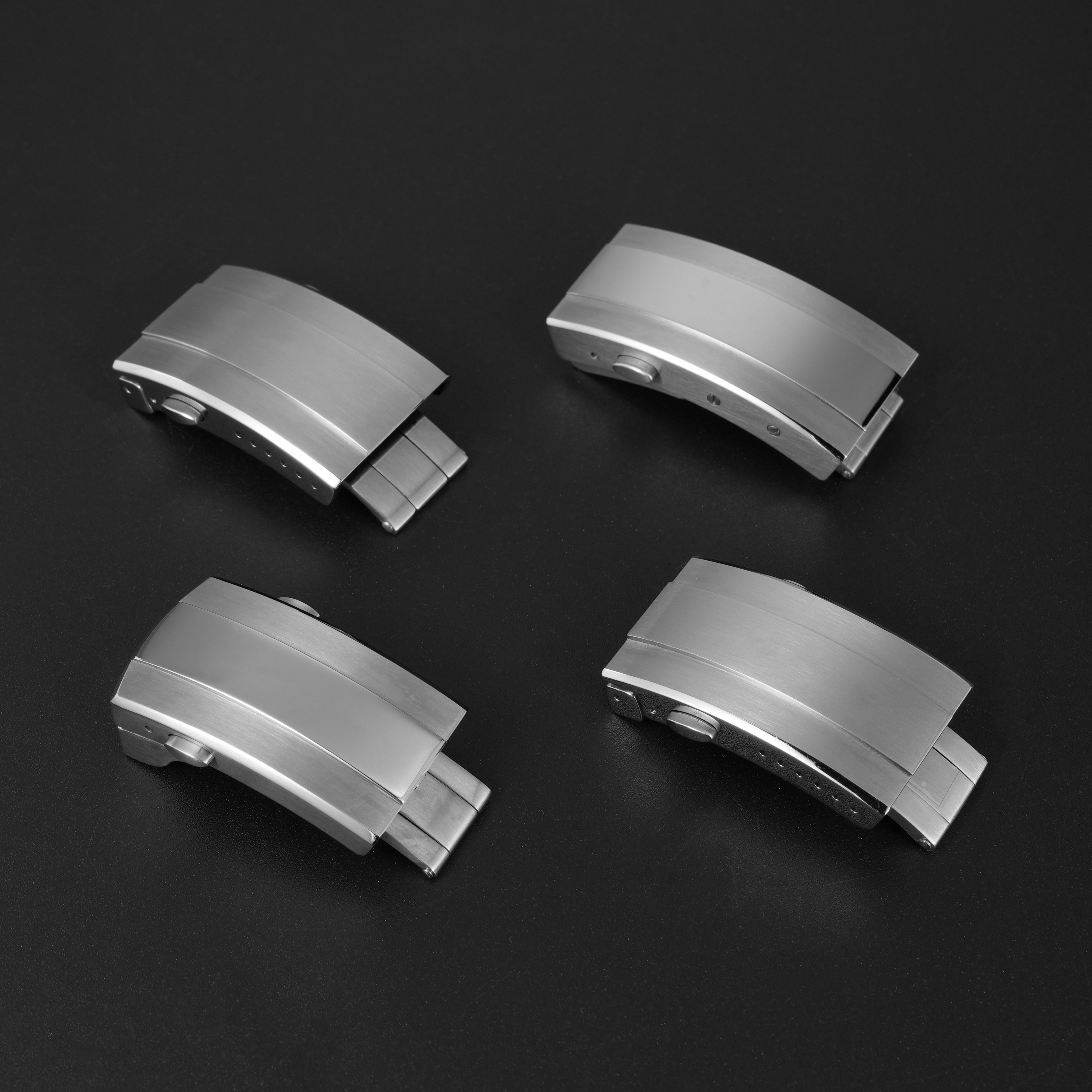
Why the Clasp Is the Brand Detail Nobody Plans For
Brand identity usually gets built around the dial, the case shape, and the logo placement. Those are the surfaces that show up in product photography. The clasp sits at the other end of the product. It gets touched dozens of times a day, seen up close by the wearer, and almost never featured in a campaign shot.
That gap is where a custom watch clasp creates the most value. Every time the watch goes on or comes off, the hand registers the shape, the weight, the edge finish, and the click. A clasp that carries a brand's design language, even quietly, reinforces identity in a way a printed logo on a dial cannot, because it is felt rather than looked at.
For OEM watch projects, custom clasps work better as a brand decision made early, alongside the dial and case, than as a finishing detail settled at the end.
Custom Clasp Design Starts With Shape and Proportion
The first decision in a custom clasp is not the logo. It is the silhouette. Outline, thickness, and corner radius determine whether the clasp reads as an extension of the case design or as a generic part that happens to match the material.
An angular case pairs better with a clasp that carries similar edge treatment, even at a smaller scale. A case built around soft curves tends to work with a rounder profile. The link does not need to be literal. It needs to be consistent enough that the eye reads both parts as belonging to the same object.
Proportion matters as much. A clasp too thick for the strap width looks oversized on the wrist. One too thin looks flimsy and undermines perceived weight. The workable range is set by strap width and case thickness, and it narrows as the watch gets more refined.
| Design element | What it signals | Common mistake |
|---|---|---|
| Outline and corner radius | Alignment with case language | Mismatched edge treatment |
| Thickness and weight | Perceived product quality | Too thin for the strap width |
| Hinge and latch position | Visual balance on the wrist | Clasp sits off center under load |
| Logo placement | Restrained or loud identity | Oversized mark on a small surface |
Logo Engraving and Marking Methods That Hold Up
Logo placement is where brand identity becomes literal. Engraving, laser marking, stamping, and etching each produce a different look and a different durability profile.
Engraving cuts into the metal and creates a recessed mark that catches light at an angle. It holds up well because the mark is part of the surface rather than on top of it. Laser marking is shallower and faster, and it works well on small marks, but a mark that is too shallow can fade with wear. Stamping suits higher volume where tooling cost can be spread. Etching handles detailed graphics but is more sensitive to surface preparation.
The real question is not which method is best in isolation. It is which method suits the material, the mark size, and how visible the brand wants to be. A mark too large on a small clasp reads as loud. One too small disappears at wrist distance.
One anonymized case involved a laser-marked logo that looked right on first samples and faded after a few months of wear. Mark depth was inside spec, but at the shallow end. Deepening the setting within the same method fixed it without touching the tooling.
Where Custom Clasp Projects Drift in Production
Custom clasps carry production variables that standard clasps do not. A bespoke outline needs its own tooling. A logo needs its own marking setup. Both are set once, then have to hold across a run.
The most common drift point is marking position. A logo that sits correctly on the first piece can shift slightly across a run if the fixture wears. The shift is small enough that each part passes inspection, and large enough that comparing two runs shows a visible difference.
The second is surface finish around the mark. Engraving and laser marking can leave a slight burr or texture change at the edge. If the finishing step after marking is inconsistent, the area around the logo looks different from the rest of the clasp.
The third is the tooling itself. A custom outline die wears, and the outline that matched the case on the first batch can look slightly different after several runs. Tracking die wear and replacing before the drift becomes visible is what separates a controlled program from one that generates late complaints.
Why Brand Identity on a Clasp Has to Survive Daily Wear
A mark on a clasp faces conditions a dial mark does not. It contacts skin, sweat, and fabric, and gets pressed and closed repeatedly. A mark that holds up in a sample case can degrade in daily use if the method and material are not matched to that environment.
The practical test is not day one. It is how the mark looks after the use the product is designed for. A shallow laser mark on a polished surface loses contrast. An engraved mark with a sharp edge collects debris. A stamped mark loses definition if the die wears. Each is manageable, but only if the marking method and finish sequence are chosen with the wear pattern in mind.
Single-Source and Multi-Supplier Setups for Custom Clasps
Custom clasp projects can be sourced more than one way, and neither setup is universally better.
A single-source approach keeps design, tooling, marking, and finishing under one workflow. Drift is easier to trace because the same team sees design intent and production result. The limitation is dependence on one supplier's capacity and one reading of the spec.
A multi-supplier approach splits work across specialists, for example a marking specialist for the logo and a stamping specialist for the outline. The advantage is narrower expertise. The limitation is that compatibility checking sits with the brand, and drift is harder to trace across two suppliers.
A one-stop components setup, where clasp production and marking sit under one roof, is one practical option among several. It reduces coordination load, but it is not the only workable path.
Small volume orders follow the same quality standards as large ones. The inspection plan and AQL levels do not change with batch size. Unit price does change, because custom tooling and inspection planning are fixed costs spread across fewer pieces. That gradient is normal, and worth planning for early.
An experienced components specialist that adheres to these standards can usually map a clasp design to the marking method it actually suits, and flag specs that sit near the edge of what the process can hold.
For projects where custom clasps need to balance brand identity, marking durability, and production consistency, working with a supplier that builds its QC around those factors reduces late surprises. Burriva, short for Baoruihua (Dongguan) Precision Technology Co., Ltd., operates a component-focused facility with over 20,000 square meters of floor space, covering multi-axis machining, CNC milling, stamping, automated polishing, and dimensional inspection across incoming, in-process, and outgoing stages. Workflows are segregated by project, and CAD file access is controlled by job role. Teams working through custom clasp specifications are welcome to discuss their requirements.
Table of Contents
- Why the Clasp Is the Brand Detail Nobody Plans For
- Custom Clasp Design Starts With Shape and Proportion
- Logo Engraving and Marking Methods That Hold Up
- Where Custom Clasp Projects Drift in Production
- Why Brand Identity on a Clasp Has to Survive Daily Wear
- Single-Source and Multi-Supplier Setups for Custom Clasps